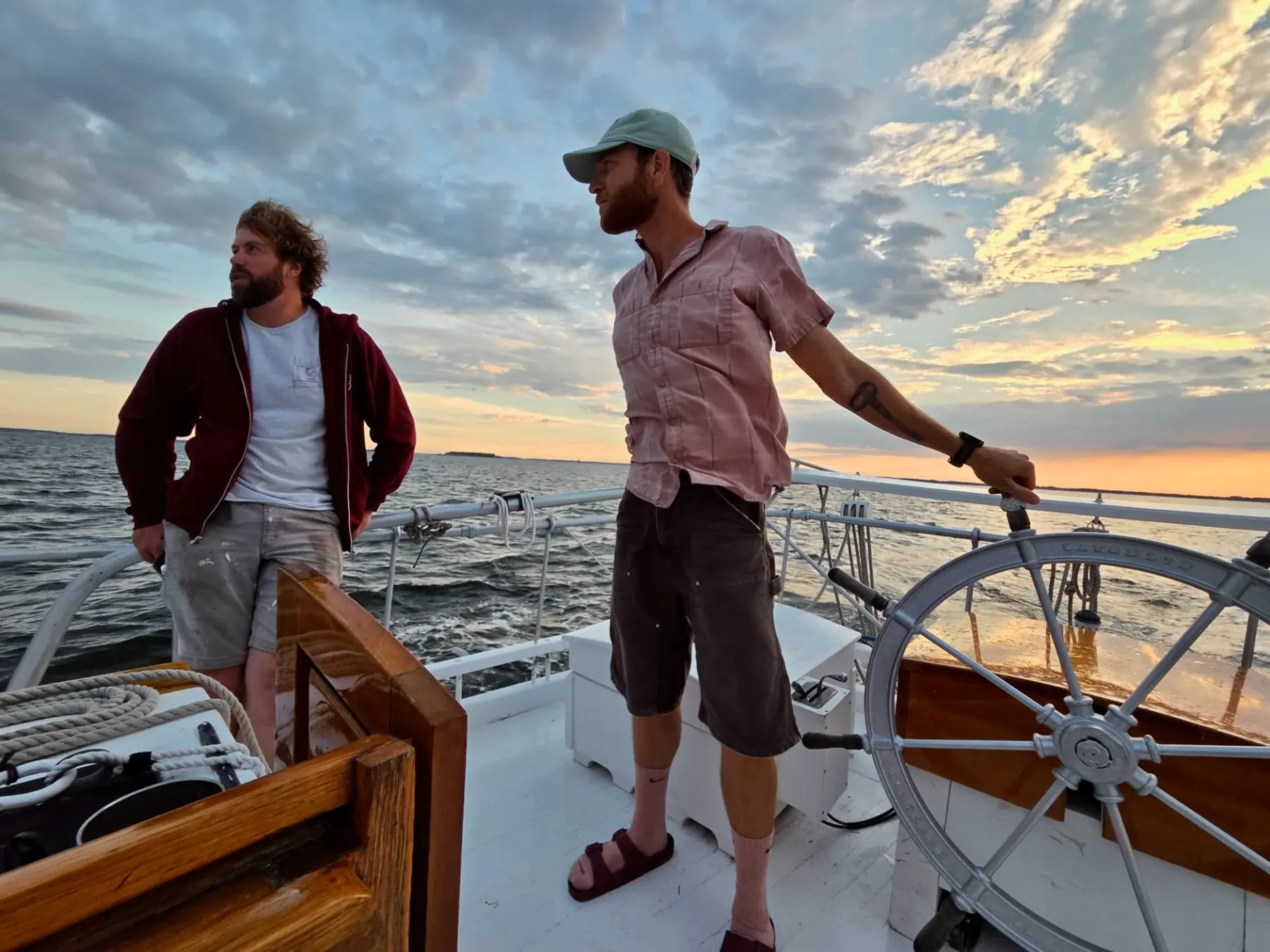
Under a waning crescent moon, the skipjack Rosie Parks slips from its dock at the Chesapeake Bay Maritime Museum. Captain Sam Hilgartner and first mate Kaeo Clarke motor the wooden sloop, sails lowered, into the slack waters of the Miles River, its engine rumbling against the rising tide. Our only company is a lone waterman leaving the dock at St. Michaels, Md., to search for blue crabs. A country song dopplers from his boat until the deadrise disappears from view. Rosie sways rhythmically beneath our feet as we push through the velvety air.
Our target is Deal Island, some 50 nautical miles down the Bay in Tangier Sound. Our 13-hour trek is timed for the island’s annual Labor Day skipjack race. However, a wall of evening thunderstorms looms in the forecast like a hard deadline.
By 8:30am, the sun has softened the sky into the pale blue of a robin’s egg. We clear Eastern Bay, and the crew steps into action. As they raise the massive canvas mainsail, it snaps against the southwesterly breeze, sending Rosie’s deck heeling gently to port. Clarke emerges from the hold with a bottle of spirits. He pours a shot into the Bay and toasts the “Old Man” to secure safe passage. The rest of our 10-person crew pass lemon-flavored Oreos to “prevent the scurvy.”
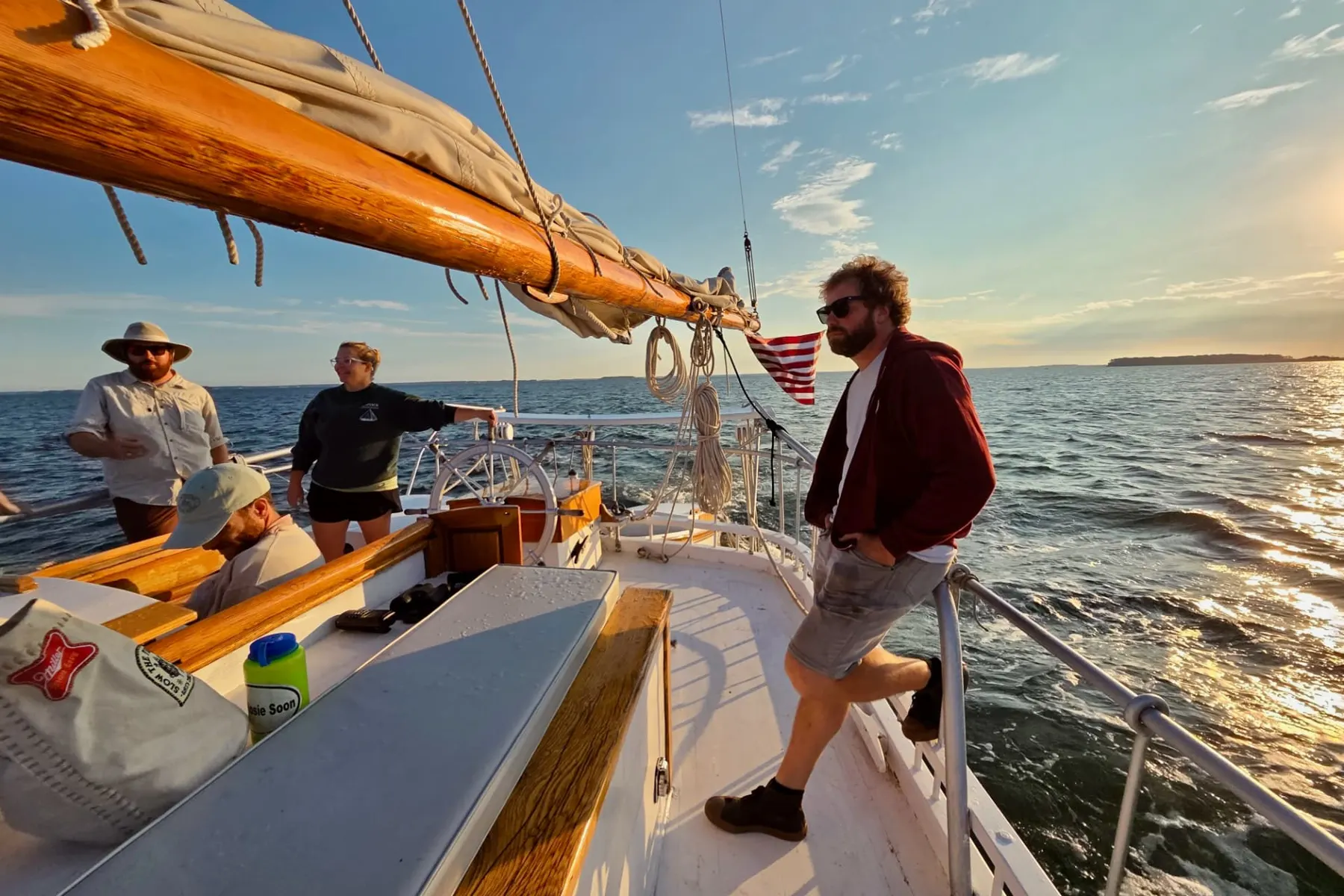
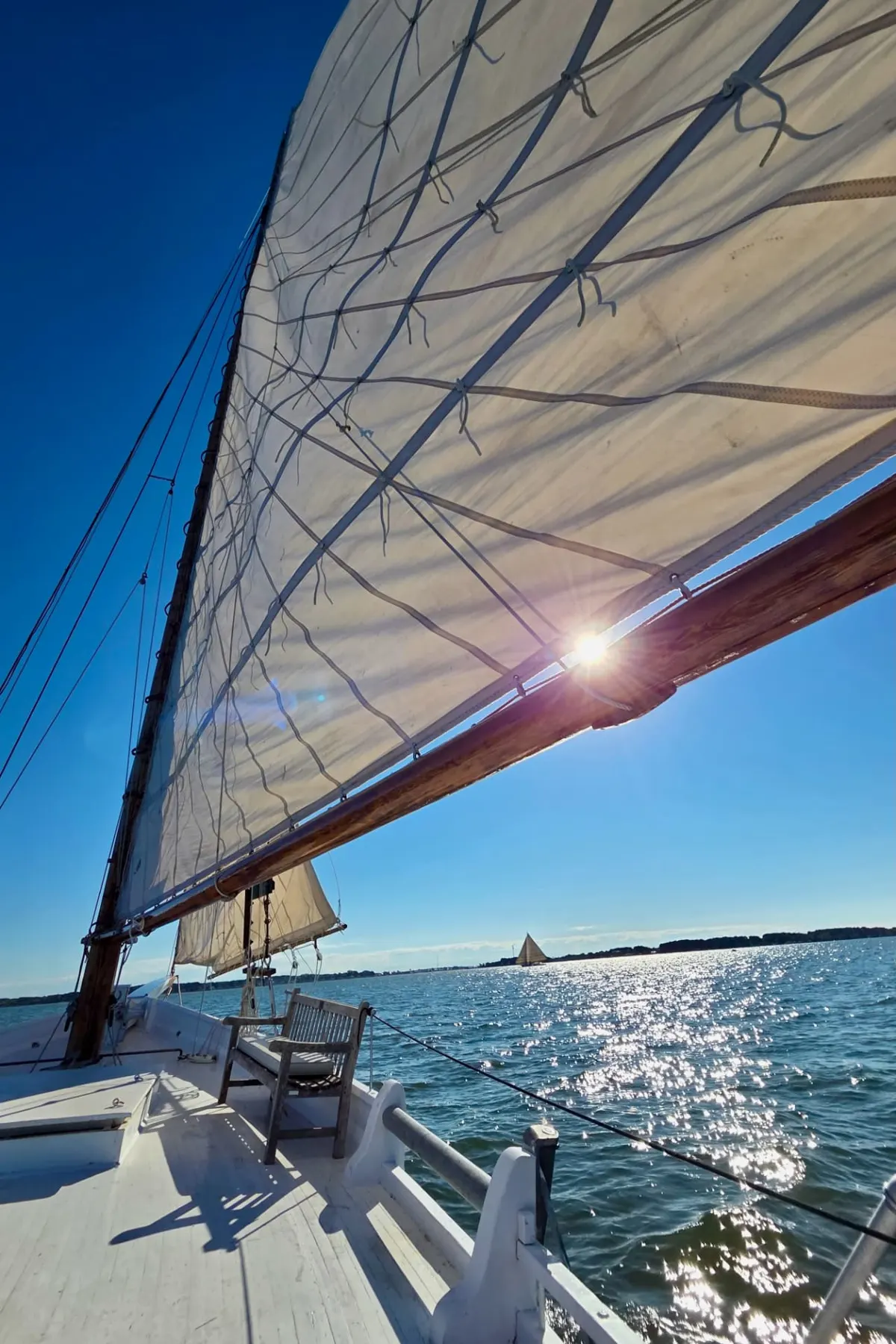
For the next three hours, we sail the lazy wind toward Hooper Strait. Rotating in one-hour shifts, we man the helm, keep watch from the bow, and tend to Rosie’s sails and lines. Hilgartner and Clarke monitor depth readings on the ship’s onboard navigation system, steering Rosie clear of shoals and shallows in the turbid green-brown water below.
The air over North America’s largest estuary is thick with the musk of brine, marine life, and decay. We spot pelicans and cormorants and pass, in slow motion, a yard patrol training vessel from the U.S. Naval Academy. The shore is never far off.
Like any journey under sail, the trip is as much a social enterprise as it is a navigational one. Down-to-earth and relaxed, our crew is a mix of CBMM staff and volunteers, along with a few guests who’ve signed on for this unique Bay adventure.
Rusty Parker, a gregarious retired Delaware state trooper and bomb disposal expert, lounges in a deck chair, soaking in the view. Nearby sits Sarah Brosh, an ICU nurse and Chesapeake native whose father captained Bay tugs.
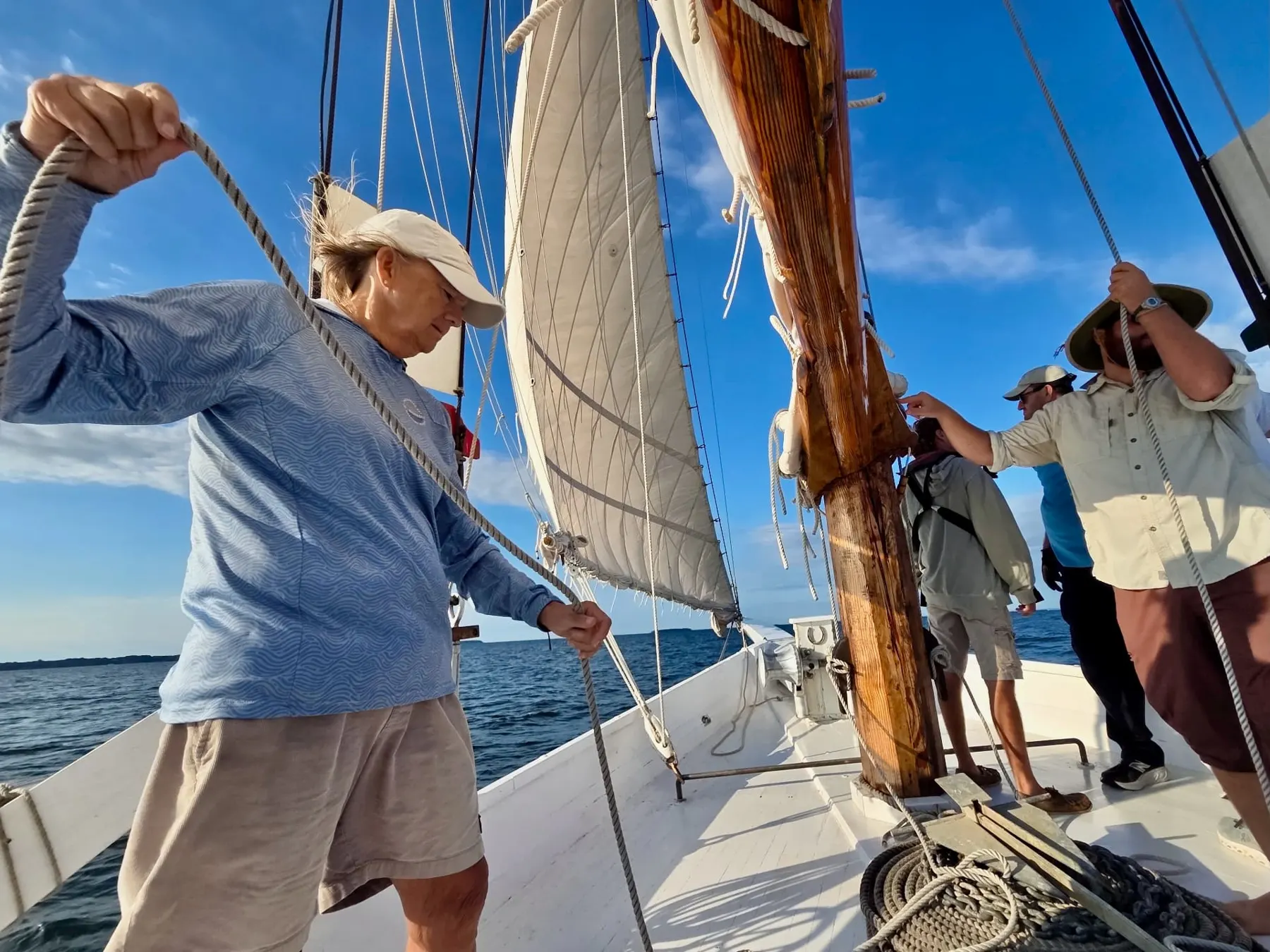
I fall into conversation with Tom Miller, who shows me how to neatly coil lines, or rope, from the mainsail in a Ballantine coil. A retired pharmacist, Miller joined CBMM’s volunteer team last year. He now works as an interpreter and, to his initial surprise, as part of Rosie’s crew. “I’ve learned how this boat works,” Miller says.
Miller tells me how skipjacks were built more or less by eye in the field. Ratios for their length and width, or beam, were determined by the length of their mast and the horizontal spars that held their main and forward sails.
Built in 1955 and twice restored, Rosie Parks is one of only about 30 skipjacks sailing today. The iconic, v-bottom sloops were designed in the late 1800s to dredge the shallowest oyster beds of the Chesapeake. With a massive mainsail supported by a raked, or backward-learning mast, the vessels were built low and wide to pull heavy iron dredge nets and carry the towering piles of oysters they hauled aboard. Rosie is less a refined nautical vessel than a sail-powered tractor, among the last survivors of an evolutionary line of working craft and a tidewater way of life unique to the Bay.
“You would never find any naval architecture book that would tell you to design a rig like this,” Hilgartner, our captain, tells me. The shipwright and master rigger notes how skipjacks break a lot of rules. “But when you put all these weird idiosyncratic things together, there’s harmony.”
Sun-bronzed, tall, and lean, the 35-year-old Hilgartner resembles a seafarer from centuries past. Today, the spell is broken by the fact that he recently lost his sunglasses and has borrowed his wife’s white plastic shades with comically large, heart-shaped lenses.
A Baltimore native who studied art in college before falling in love with ships, Hilgartner works as CBMM’s vessel conservation manager, overseeing its collection of historic boats and working Shipyard. CBMM displays dozens of traditional Chesapeake vessels across its 18-acre campus, including a floating fleet maintained in operating condition. Last year, Hilgartner and his colleagues completed a bow to stern refit of Rosie, ensuring its future on the Bay.
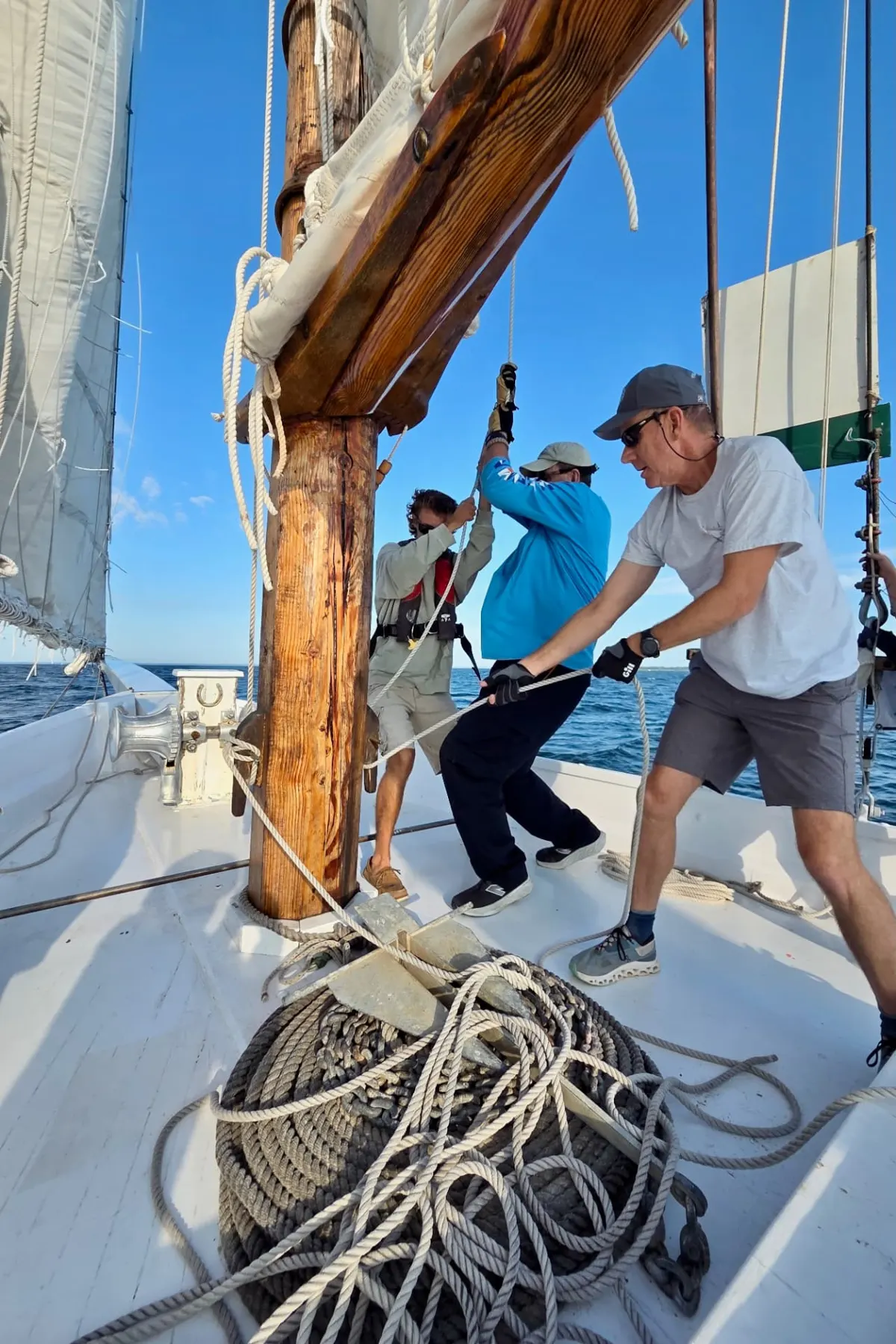
For the crew, affection for Rosie and the skipjack fleet runs deep. “Skipjacks are my absolute favorite thing in the whole wide world,” says Leigh Auth, a friend of the boat who works for the Maryland Department of Natural Resources. The Annapolis native says she loves the people and culture that support skipjacks, a style of boat found nowhere else in the world.
“You have some skipjacks that are still preserving the history of what these things did. Still dredging with them, still using them to get oysters,” she says. Meanwhile, other skipjacks like Sigsbee and Wilma Lee do the opposite. “They’re going out and putting oysters back on reefs with kids and students and teachers.”
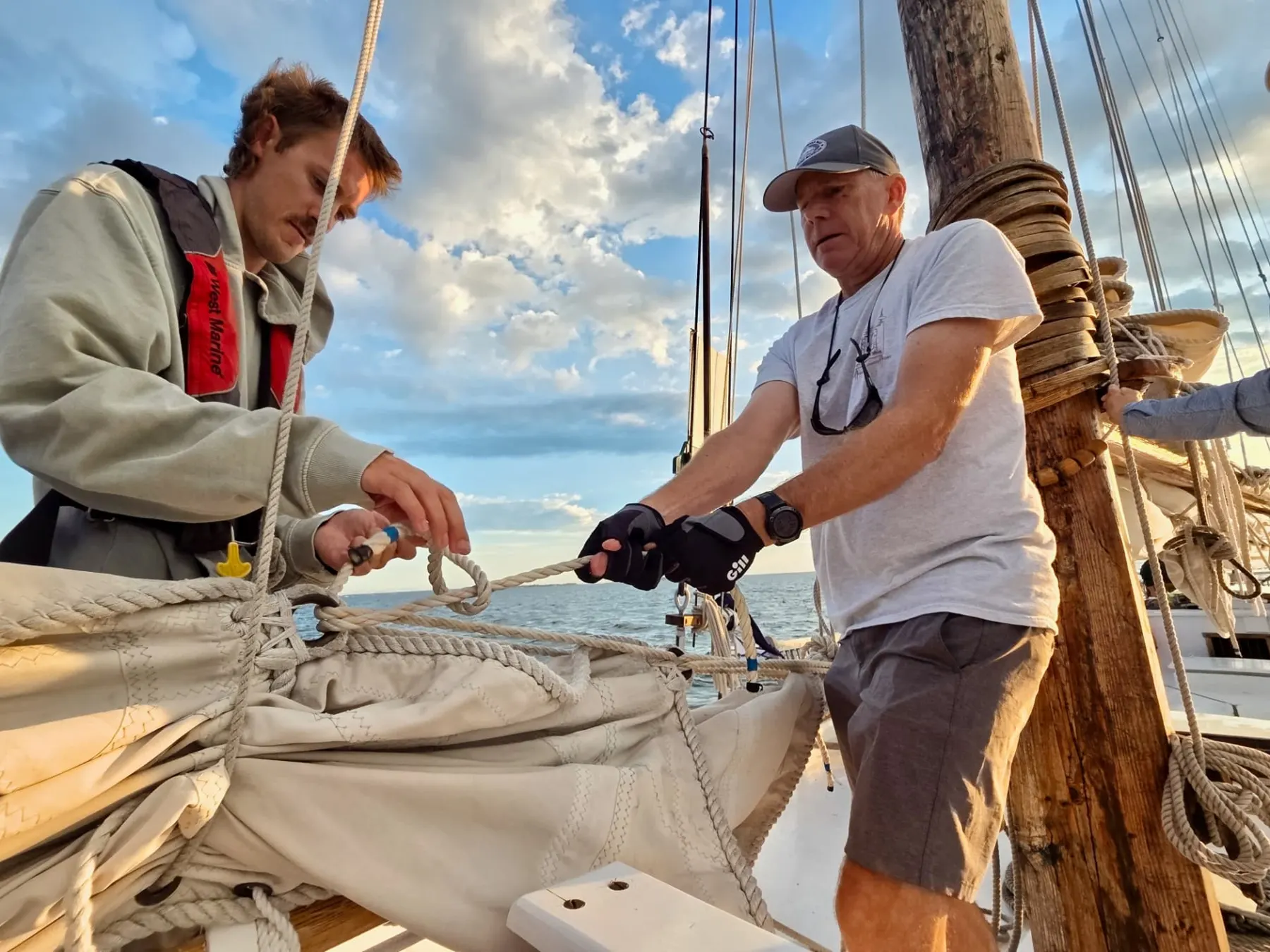
By noon, the wind has died. Hilgartner and Clarke, the first mate, order the crew to take down the sails. Caden Lewis, a 20-year-old St. Michaels native now in the second and final year of CBMM’s state-certified apprenticeship program, climbs out onto the bowsprit like a steelworker skirting a beam high above the city. He helps volunteers Tom Miller and Sue Abrahams stow the jib and tie the mainsail to the boom.
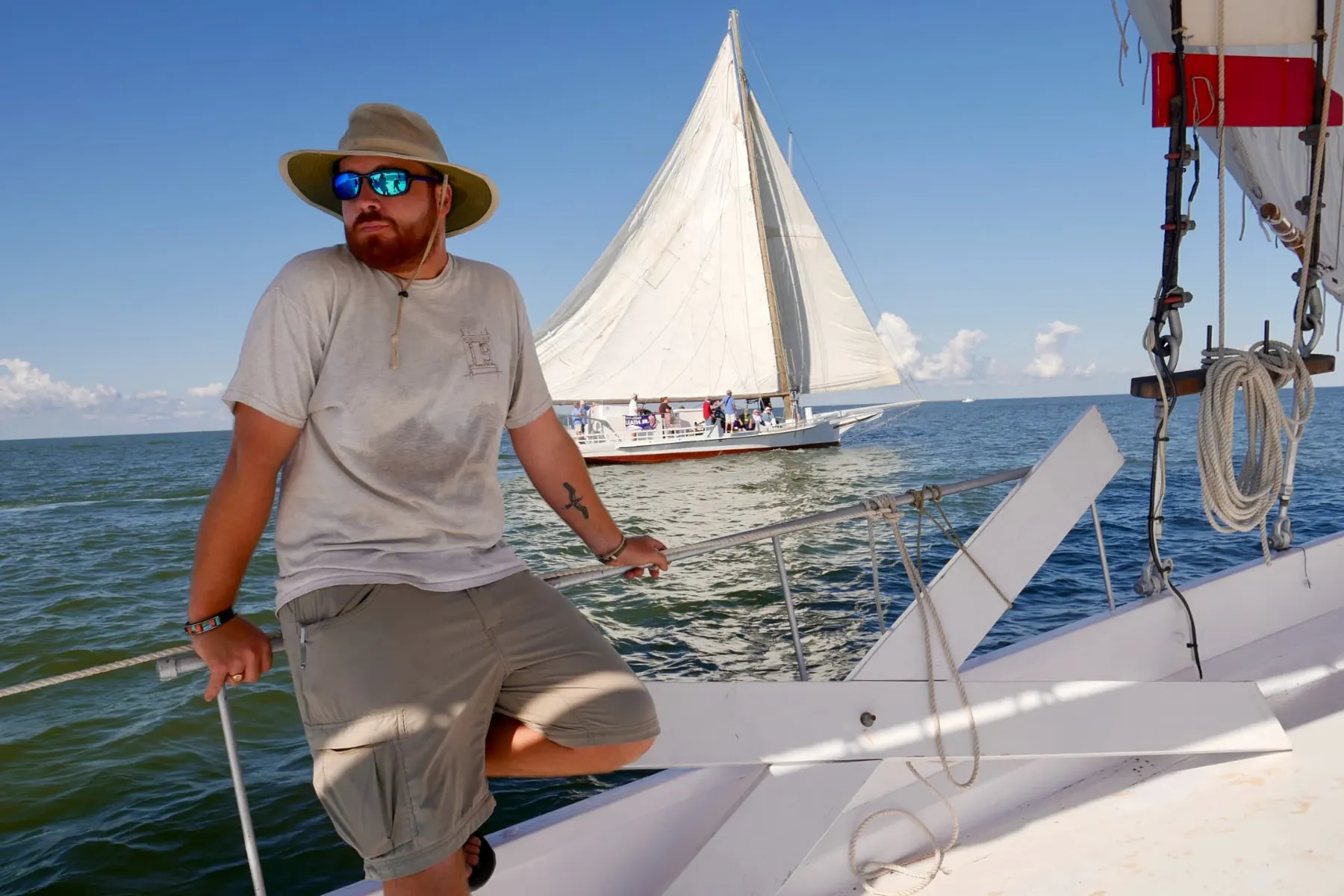
Rosie Parks now forges ahead, pushed by its diesel engine, at a stately six knots. The temperature climbs into the 90s with humidity to match. With the mainsail down, there is no shade. Clarke hangs a long tarp of black mesh from the boom, and those of us not on watch stations gather under its shade.
Shipwright Alex Bell retreats into a hammock he has tied against the mast, his passion for Rosie evident from a tattoo of the skipjack on his right thigh with the motto, “Rosie’s a Great Gal.” Abrahams and Miller play a round of backgammon.
“Sailing, there’s not much to it,” Clarke says to no one in particular, settling into a deck chair.
Clarke is easily the crew’s most experienced sailor, serving as captain for many of Rosie’s expeditions from April-November. Born into an Annapolis sailing family, his parents pulled him and his sister out of school when he was 10 and spent the next five years sailing the Eastern Seaboard and Caribbean. So when Clarke declares that “Boring trips are good trips,” I take him at his word.
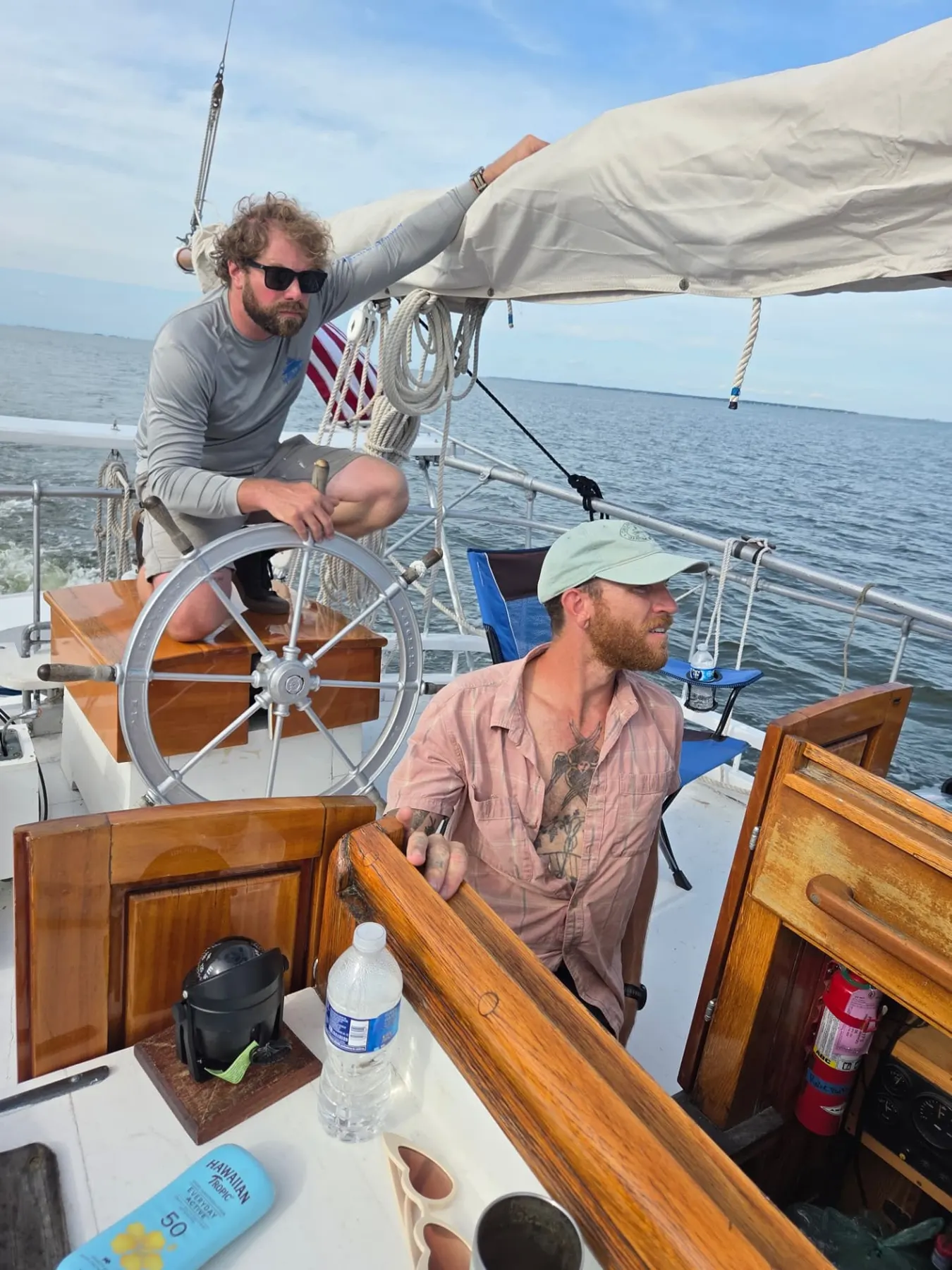
A while later, Hilgartner leaves the helm to talk in the shade as Rosie skims across the sparkling waves. He says people sometimes romanticize the work of restoring and sailing historic ships, noting that it is not all glorious. He points to a recent stretch of long hot days that he and Clarke spent laboring in Rosie’s bilge. “We were just working in the bilge, carving out old pieces of keel and working with roofing tar and lead and bumping our heads up on the deck beams.”
“But then,” he says, nodding toward the horizon, “there are days like this. You have to take it all.”

By late afternoon, we round into Tangier Sound and spot the bridge and harbor of Deal Island. A bruised sky to the northwest carries the thunderstorms we raced against and won. Hilgartner takes the helm and guides Rosie through the complicated channel toward the dock.
Several other skipjacks are already there, poised for Monday’s skipjack festival and race. Now in its 67th year, the community celebration draws spectators from across Maryland’s Eastern Shore and beyond. This edition features a work boat docking contest, fishing tournament, and an Elvis impersonator.
A local waterman grabs our line and helps us tie up. He tells us that the volunteers who run Deal Island’s Skipjack Heritage Museum heard we were arriving and stayed open late, just for us.
It’s been a long, hot day, and the promise of hot showers and home beckons as we pile into our shuttle van. But as we pass the museum, Hilgartner tells the driver to stop.
We step inside to find three silver-haired volunteers. Clearly delighted by our arrival, they chat animatedly as we browse the collection packed with skipjack ephemera, hand-carved model ships, and faded photographs of ships, local watermen, and their families.
Pointing to a list of skipjack race winners on the wall, one volunteer tells me her father and uncle both worked on skipjacks—and that both were lost to a sudden storm on the Bay when she was a young girl.
Standing in the homey gallery, the significance of our stop strikes home. Skipjacks are more than museum pieces or historic relics. They are part of the living memory of the Bay, kept afloat by the communities that love them.